
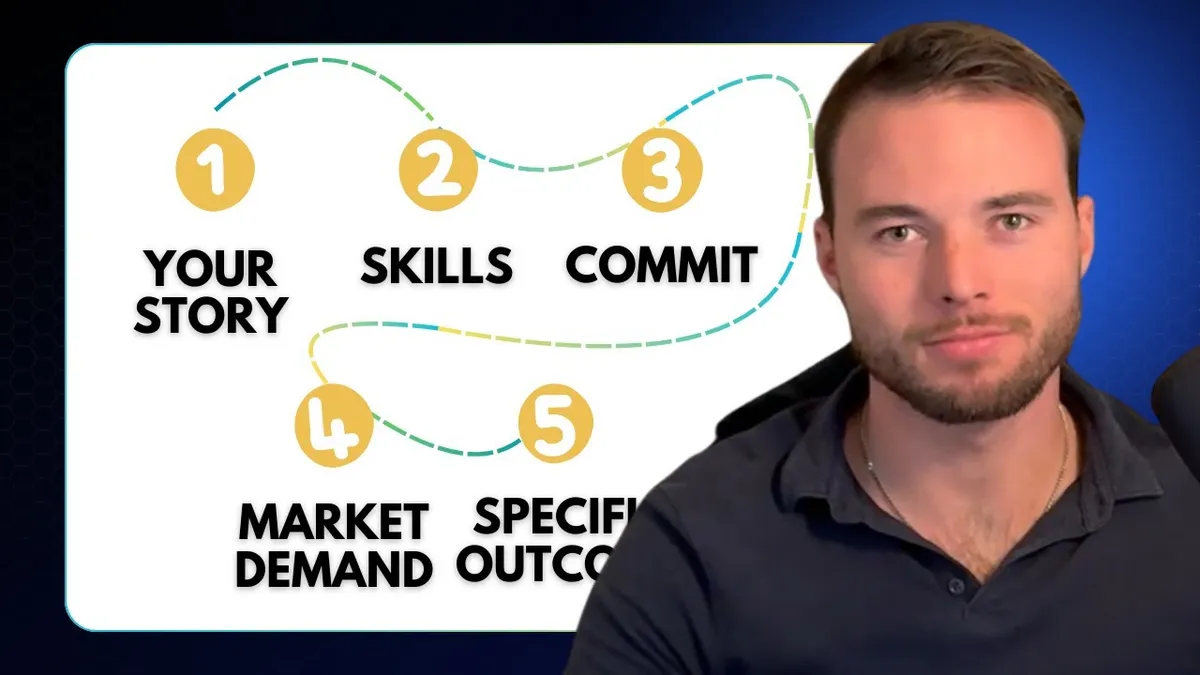
How to Choose a Coaching Niche: A Simple 5 Step Framework
You know you want to be a coach, but you have no clue what niche to pick or what path to go down. That's one of the most common places new coaches get stuck. In this post I'm going to walk through how to choose a coaching niche with a simple five step framework, plus the biggest mistake that keeps coaches stuck in indecision. The goal is to help you avoid two traps: a niche you don't enjoy, and a niche that can't make money.
What a coach actually does
Before the steps, let's make this simple. A client is at a point right now, and their goal is somewhere above that. There's a gap in between. Could they figure it out themselves? Sure. But most people don't. If they had all the tools, the information and the accountability, they would have done it already.
Picture it like a staircase with five steps. They might have steps one, two, three and five, and not even realize step four is missing. They won't reach the goal until they have it. As a coach, you're the one handing them the missing steps.
That matters for picking a niche, because it means you don't need to promise the world. You need to have done something, and know how to help someone else do it.
Want to go even deeper? Watch the full video.
Step 1: Start with your story and experience
Ask yourself what you're actually qualified to do. What have you gone through? What can you offer that's of value to someone else? It could be job experience, life experience, getting a certain kind of job, staying in a job for years, having a happy marriage, being good at dating, losing weight. Whatever it is, it doesn't have to be grand.
One of the biggest fears I hear is "I'm not qualified enough. Other people are more qualified." Think about me in my business. Are there people with way more experience than me? Of course. People who've been in business for decades longer. Does that mean I can't provide value? No. I know I can give people clarity and help them reach their goal. Same with you.
My recommendation is to pick something you've actually done, not something you just learned online. You'll speak to it with more confidence. If you're still unsure whether you can coach at all, read can anyone become a personal coach.
The person you used to be
Here's something that has helped a lot of coaches I talk to. The person you're most qualified to help is often the person you used to be, whether that was 3, 5, 10 or 15 years ago.
Say you were 50 pounds overweight and now you're 10 pounds overweight. You're not a bodybuilder. But you learned real skills to get from 50 down to 10, and there's value in teaching that. You're just documenting your steps and helping someone else go through the same process.
Step 2: Clarify your strengths, skills and passion
Step one gives you a longer list. Step two starts to narrow it. Ask yourself:
- What do people naturally come to you for?
- What topics could you talk about for hours without getting bored?
- What have you studied, practiced or taught for years?
- Could you see yourself doing this for the next 5 or 10 years?
That last one matters. If the answer is no, sit back and ask why you're doing it. If it's a quick cash grab, okay. But if you want to build a proper coaching business, plan for the long term.
There are people who say you don't need to be passionate about your business to make money. That's true. Plenty of business owners aren't passionate about what they do. But when you enjoy it, showing up every day is a lot easier. It makes it easier to keep going.
Step 3: Validate the market demand
Now check that people actually want this. A rule of thumb: if you're looking to make around $100,000 a year, nearly anything can work. Not every single thing, but there are enough people out there who want what you have, however niche it sounds. If you want to grow bigger, this step matters even more.
The second question is how easy it is to get traction. There's an analogy Warren Buffett uses about what boat you're in. One boat is sturdy, has a motor, and is going down river. The other is a heavy wooden boat full of holes, with only oars, going against the current, and you're bailing water just to stay afloat. Market validation tells you which boat you're in.
How to check:
- Google and ChatGPT: search the questions your ideal client would type when they're stuck.
- Facebook groups, Reddit and YouTube comments: see what people are struggling with right now.
- Competitors: pretend you're shopping for this coaching. What's out there? Do they look like they're making money?
If you find nothing and nobody is asking these questions, either you're looking in the wrong place or there isn't much demand. Look in other places and talk to people before you decide.
Step 4: Name a specific outcome
A lot of coaches are really generic. "I help people in health." "I help people live their best life." That puts you in the same bucket as everyone else.
Get clear on the exact goal you help someone reach, and who that someone is. For example:
- Instead of "I help people live their best life," try "I help moms lose 20 pounds without giving up wine."
- Or "I help burned out nurses quit drinking and feel alive again."
The more specific the outcome, the easier it is for the right person to see themselves in it. Once you have it, the next step is building it into an offer. Here's the first step to starting a coaching business.
Step 5: Commit
By now you should have the one. Now you need to commit to it. Starting a business is simple, but it's not easy.
Here's the pattern I see. You start with uninformed optimism. "Weight loss coaching is going to be great." Then you hit informed pessimism. "This is tough." Then the valley of despair. "I have so much to learn and build." That's where most people quit and switch. "Health coaching doesn't work, I'll do relationship coaching." Then they start the cycle again, over and over, and never get results. The people who push through get to informed optimism, and then to the part where things are working.
Things usually take longer and cost more than we expect. So pick something you're willing to do for a long time, and stick with it.
The biggest mistake: waiting for perfect clarity
The number one mistake is wanting perfect clarity before taking action. You're never going to have it. It's not always going to make sense.
The term I use with the people we work with is imperfect action. I meet so many coaches who spend months or even years on this process. It doesn't need to take that long. You can go through these five steps in a couple of days, a week, or a month at most.
"Now isn't a good time." "The economy is bad." "I'm really busy." I understand. But there will be another busy time in the future. Are you going to stop your business then too? Take a little action, then a little more, and keep moving to the next step.
FAQ
How long should it take to choose a coaching niche?
Not long. You can work through these five steps in a few days to a month. Spending months on it usually means you're waiting for a perfect clarity that never comes.
What if I'm not qualified enough to coach?
You don't have to be the best in the world. If you've done something and can help someone get from where they are to where they want to be, you can provide real value.
Can I change my coaching niche later?
You can, but switching every time it gets hard keeps you stuck. Do your research up front, pick one, and give it real time before you decide.
If you want help putting this in place, apply here: td.coach/coaches-apply