
How to Create a High Ticket Coaching Offer, Step by Step
Most coaches charge way too little. They look at what everyone else charges per hour, go a little lower so they don't rock the boat, and then wonder why selling feels like a fight. In this post I'm going to walk through how to create a high ticket coaching offer step by step: why the size of the problem sets your price, the four levers that make an offer more valuable, how to pick the number, and what to actually put inside of it.
Step 1: The bigger the problem you solve, the more you can charge
If you price by the hour or by "the market rate," you become commoditized. Basically, you look the same as everyone else. And when a prospect is choosing between you and the next person down the street, the only thing left to compare is price.
And so it turns into a race to the bottom. "I'm cheaper than you." "Well, I'll go cheaper, I need the client." It keeps going down and down.
The fix is to focus on the problem and the outcome. You want to move the person away from the pain they're in right now and toward their long term goal. When you do that, people can justify paying much more, because they're paying for the outcome, not your time.
Here's the thing. It can be the exact same work. Compare these two pitches:
- Hours: "We'll work together for 3 months, one call a week, so 12 sessions, for X dollars."
- Outcome: "You said it's really important for you to accomplish this. Here's the step by step process we use to get you there, and it's only Y dollars. How would you like to move forward?"
Same coaching. The second one sells better, it supports a higher price, and people see it as more valuable. If you're still deciding between those two models, I wrote more about charging per session vs selling a package.
Want to go even deeper? Watch the full video.
Step 2: Use the four levers that make an offer valuable
There are four parts that decide how valuable your offer feels. Two you want to push up, and two you want to push down.
Lever 1: The size of the outcome
The bigger the outcome, the more valuable the offer. "I'll help you make $10,000" is worth less than "I'll help you make $100,000," which is worth less than a million. Ask yourself how you can make the result you're promising as big and as clear as possible, while still being honest about it.
Lever 2: How likely they believe it is
Multiply the outcome by how likely the person feels they are to actually get it. If I promise you a hundred million dollars but there's almost no chance, that promise isn't worth much.
So how do you raise the odds in their mind? Guarantees, case studies, and testimonials. You want to be able to say, "Look, I've done this many times. You're just the next person, and we can go ahead and do it again."
Lever 3: How long it takes
Now the bottom half. If you can get me the same outcome in a week instead of a month, a year, or ten years, the week is worth more to me. Cut the time it takes as much as you can.
Lever 4: How much effort it takes
Say I tell you, "I'll get you $10,000, it's risk free, it's only 4 weeks, but you can't sleep, you have to put everything else on hold, and you'll probably get sick." That's a lot of effort. Most people won't do it, and so the offer is worth a lot less. The less effort you make it, the more valuable it becomes.
Step 3: Reframe what you already do
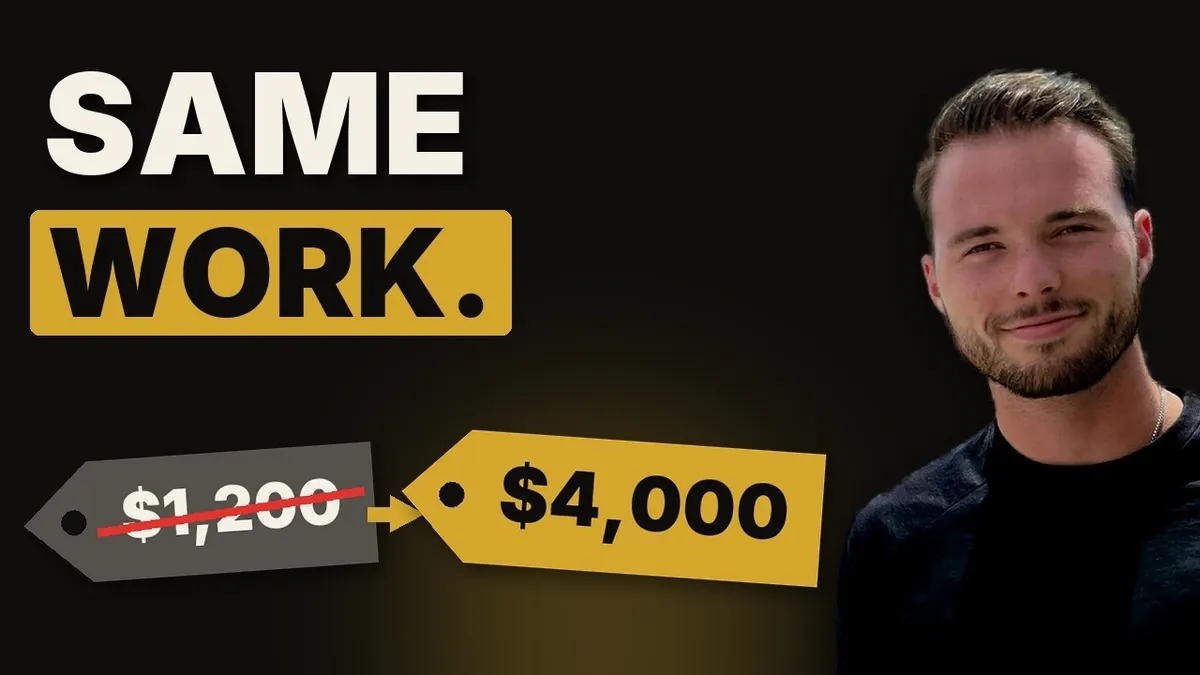
Let's put that together with real numbers. Say you're a coach charging $100 a session. Twelve sessions is $1,200.
Now reframe it. Instead of "we'll have 12 sessions to work on your marriage," it becomes: "We have a proven step by step process to get you this outcome. I'm confident we can get you there, and we have a guarantee in place. It's 3 months. The biggest thing I need from you is to show up each week and do a couple of things."
Now it can be $4,000 for 3 months to get this resolved. And if they say, "That's so much money," you attach them back to what they told you. What's more important, the $4,000 or the foundation of a healthier marriage? Or skills they'll use for the rest of their life?
Step 4: Set the price based on value, not cost
So what do you actually charge? It comes down to value compared to price. If you give someone $5,000 of value and charge $5,000, fine, it's a fair trade. But that's not what you want. You want the gap between the value and the price to be big. The bigger that gap, the more the person wants to move forward.
Two guardrails here:
- Keep it believable. The value has to be within reason, so they don't think you're inflating it.
- Leave room for delivery. Your price needs plenty of room above what it costs you to deliver the service.
A lot of newer coaches have a limiting belief here. "I can't charge that much." But your ideal client will happily pay to solve their problem if you give them a real way to do it. If you're unsure, book a couple of calls with competitors to see what they charge. Most of the time you'll find you can charge a lot more than you are right now. And ultimately, the people you talk to decide whether the price is right, so ask them how much solving this is worth to them. For newer coaches, here's more on what to charge as a new coach.
Step 5: Decide what goes inside the offer
The last step is the specifics. What do you include?
My recommendation for most coaches starting their first high ticket offer is to start with one on one. You do the work with each client, and while you do it, you build the assets you'll use later. Record your client calls. Make templates, videos and SOPs for the questions that keep coming up. Now you have resources you can give every client, not just one.
The more you can productize your service, the easier things get. If every client goes through the same step by step process, you need less mental bandwidth to deliver it, and you can hire other coaches while the quality stays high. I broke down a version of this in how we structure a coaching program.
As more people join, you can add a community and group calls. You can even keep the one on one plus the group calls. A lot of people's questions overlap, so instead of answering the same thing over text again and again, it all flows into one call.
FAQ
What counts as a high ticket coaching offer?
It's an offer priced on the outcome it gets someone, not on the hours you spend. The price is set by how big the result is, how likely they are to get it, how fast, and how much effort it takes them.
How do I know if my price is too high?
Talk to your ideal client. The people you get on calls with tell you whether the price fits. Looking at what competitors charge also helps, and most coaches find they can charge more than they thought.
Should my first high ticket offer be one on one or group?
Start one on one. It lets you learn what clients need and build the videos, templates and recordings you'll later use for group calls or a community.
If you want to keep working on this with other coaches, join the free community here: td.coach/skool-start